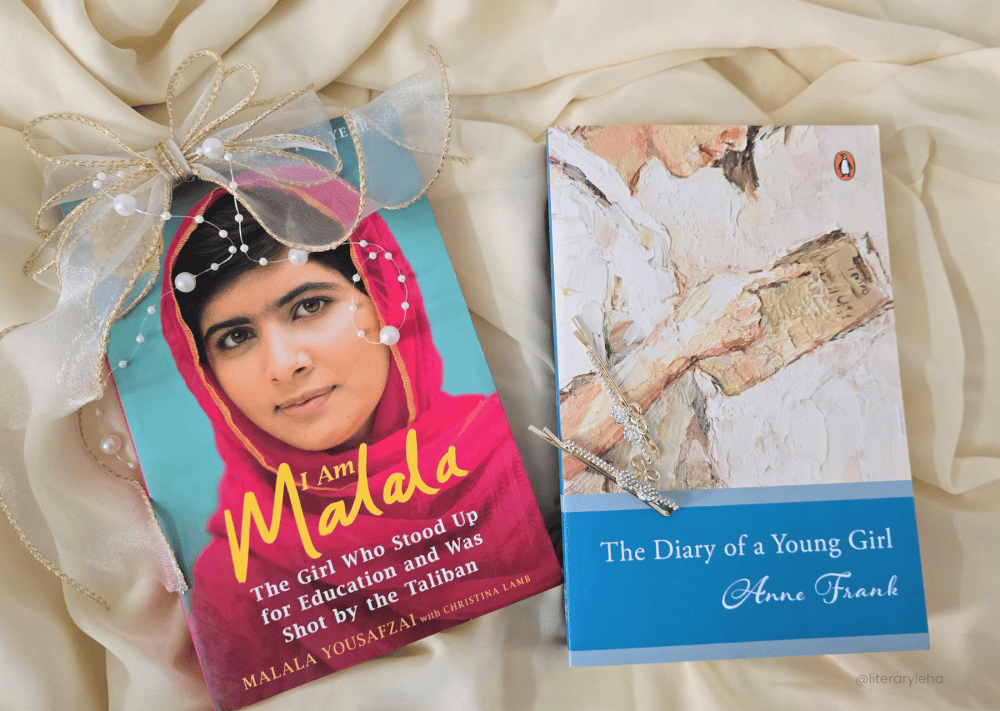
I had never thought of the books I Am Malala and The Diary of a Young Girl together. Malala Yousafzai and Anne Frank lived decades apart and their stories cannot be compared. Yet somehow, in 2026 India, both their books ended up at the centre of the same controversy.
You probably came across the Ahmedabad incident. Both these books were on a reading list connected to the book club at Anand Niketan School in Shilaj. What began as a parent protest over a piece of glass allegedly found in school food eventually included objections to these books. The protests grew, and the books were later dropped from the list. Neither was part of the formal curriculum.
It got uglier when people gathered at AUDA Garden in Vastrapur for a silent reading session. They were reading Malala, Anne Frank, Bhagat Singh, Che Guevara and other writers when a group arrived and disrupted the gathering. Participants alleged that they were assaulted with sticks and iron rods, and arrests followed.
People were attacked for reading in a garden. I never imagined I would type that sentence.
What makes Malala dangerous?
I Am Malala takes us to Pakistan’s Swat Valley, where Malala grew up loving school while the Taliban gradually tightened its hold over the region. At 11, she began writing anonymously for BBC Urdu about life under Taliban rule and the restrictions on girls’ education. In 2012, when she was 15, a Taliban gunman boarded her school bus and shot her in the head.
The book is as much about her childhood, family and home as it is about extremism. It is so powerful because it shows how scary it is when simple, ordinary freedom begins to disappear. A girl wanting an education should hardly be revolutionary, yet the Taliban found the idea threatening enough to try to kill her.
“We realize the importance of our voices only when we are silenced.”
One of the objections being raised against Malala now is what she said about Kashmir in 2019. After Article 370 was revoked, she spoke about the effect of the restrictions on Kashmiris, particularly women and children. She later asked international leaders to listen to Kashmiri voices and help children return safely to school.
She has been criticized for not speaking as strongly about the persecution of minorities in Pakistan. What she did not do was advocate violence against India or call for Kashmir to become part of Pakistan.
Also, I Am Malala was published in 2013. Her Kashmir comments came in 2019. Holding a book responsible for something its author said six years later is certainly an interesting approach to literary criticism.
And what did Anne Frank do?
I read Anne Frank around the same age she wrote her diary. 13. As a teenager I found the book so raw and beautiful and in many of her words I felt heard.
When her Jewish family went into hiding in Nazi-occupied Amsterdam, for more than two years, she wrote about life inside the Secret Annex before the family was discovered in 1944. Anne eventually died at Bergen-Belsen concentration camp.
Anne wrote about normal things in her diary. She wrote about family tensions, growing up and her dream of becoming a writer, while we read knowing that the future she imagines will never arrive.
“I want to go on living even after my death!”
Six million Jews were murdered during the Holocaust. Anne’s diary allows us to know one of them as a person rather than a mere number in a history book. It is difficult to imagine why that is something children should be protected from.
The objection to Anne seems to have had little to do with anything she actually wrote. Parents protesting outside the school reportedly questioned why students were being asked to read books “written by authors of other religions”. Apparently, being dead for more than eighty years isn’t enough to keep you out of India’s culture wars.
Apparently, knowledge is uncomfortable
Both these books give young girls a voice.
We talk endlessly about educating and empowering girls, but empowerment isn’t always convenient. Education gives people the ability to question what they are told, including what governments, religions and societies tell them.
In today’s India, “anti-national” has become an easy label for uncomfortable opinions. Journalists, activists, academics and political opponents continue to face growing pressure.
International democracy monitors have also been warning about India’s democratic decline for years. Freedom House’s 2026 report classifies India as “Partly Free”, while V-Dem has documented the weakening of democratic institutions and freedom of expression.
We should worry about how comfortable we are becoming with this direction. Disagreeing with what someone writes is normal. Deciding that nobody else should get to read it is something else entirely.
The more we read, the harder it becomes to accept everything we are told without question. Maybe that’s why controlling what people read has always been so tempting to those in power.
So the books came out again
After the violence, Ahmedabad continued reading.
People gathered again in public gardens with books, turning something as simple as reading into an assertion of freedom.
There is something frightening about having to defend the right to sit in a public garden and read a book. Sometimes it really does feel like we are living in a dystopian era.
Malala and Anne do not belong to the same story, but both wrote from worlds where their freedom was being decided by someone else. One fought for her right to learn and survived an attempt to silence her. The other wrote while hiding from people who had decided she did not deserve to exist.
We seem to love the idea of empowered girls until they read, learn and form opinions we don’t particularly like.
And somehow, all of this made me reach for these two books again. Now they’re back in the light.
This article is part of Blogchatter Half Marathon 2026, a 15 day blogging challenge.


I didn’t follow these stories from media. Thanks for sharing. That’s not good to protest against these books. I heard a lot of praise about both the books, but never got opportunity to read about them. The reason that the authors are from different religion doesn’t seem reasonable to ban a book from reading.
LikeLiked by 1 person
Exactly. And both books are so worth reading. Do pick them up if you get the chance!
LikeLike
It’s the right of expression of an Author to bring out the best content thru’ his/her writing but unfortunately the powerful around come in the way of that expression. Highly informative Post. Thanks for sharing!
LikeLiked by 1 person
Extremely interesting read. I have read both the books but I did not know about the controversy. To read books only by authors of a certain religion is narrowmindedness in the extreme. Why should religion be connected with everything, specifically, reading ? In today’s times every uprising is orchestrated to pass on a single message – your freedom is subjective. If you fit into a mould you are so called free otherwise not. In the process we forget our so called intelligentia was shaped by western education, which again implies getting enlightened by reading thinkers and philosophers belonging to another religion.
LikeLiked by 1 person
You’ve said it so well. Freedom seems like something imaginary these days
LikeLike
You’ve said it so well. Freedom seems like something imaginary these days…a myth
LikeLike
It’s horrifying! I didn’t hear of the Ahmedabad incident until I read it here and my blood runs cold. Diary Of Anne Frank was a LangLit textbook in my daughter’s Secondary school.
LikeLiked by 1 person
Yeah, it has been for so many years, in so many schools. So it is ridiculous what is happening these days.
LikeLike
A thought-provoking piece. Whatever our personal views, the freedom to read, question and discuss ideas peacefully is fundamental. Books should open conversations, not become reasons to silence them.
LikeLiked by 1 person
”The more we read, the harder it becomes to accept everything we are told without question. Maybe that’s why controlling what people read has always been so tempting to those in power.”
This is such a powerful thought very relevant in the times we live in. Your post is thoughtful as well as sensitive.
LikeLiked by 1 person
Thanks so much.
LikeLike
I never analysed the two books this way. Your post gave me a different perspective and more the reason to laud these women
LikeLiked by 1 person
Thank you!
LikeLike
India is supposed to be a democracy but is slowly moving towards autocracy. History had kings who killed writers they did not like or banished them. Imagine creating a riot in a school over books which were not part of the sylabii. You were too young to read Anne Frank, Leha. Although i too read books that were way ahead of my age.
LikeLiked by 1 person
So true… I feel we are turning into a dictatorship. Yeah, I was young, but found her so relatable. Wanted to be her friend.
LikeLike
I started reading because a friend got me into it, but I started writing after our English teacher in class 10th fought for us to read The diary of a young girl for our syallabus rather than The autobiography of Helen Keller because that was the only books available in library. And so she and us arranged a few of our own, shared and read it. She knew that we might need this book more at that time. And she was right. I started writing after I came across this quote in Anne Frank’s book – ‘Paper has more patience than people’, a quote that I can never forget. To see people objecting for this book just shows how they haven’t read it themselves. And that is more frightening!
LikeLiked by 1 person
Exactly. That is quite scary. I love that quote too. It has stayed with me ever since.
LikeLike